


Vote Like Your Plate Depends on It

Why Vote Early Day Is a Food Democracy Day

The ballot box may feel far from the kitchen table but is not.
On October 24, 2026, the country marks Vote Early Day, a nonpartisan civic holiday created to encourage Americans to learn about their voting options and make their voices heard before Election Day. In 2024, more than 85 million Americans voted early, and Vote Early Day now works with more than 1,000 partners across the country.
At WANDA, we believe this day should also be understood as a food democracy day.
Because the people we elect and the institutions they oversee shape what eventually lands on our plates. They influence food safety, farm policy, SNAP, school meals, water quality, pesticides, environmental protections, agricultural research, Food Is Medicine, maternal health, and whether small farmers and historically excluded communities can build wealth through the food system.
We are not just consumers. We are food citizens. And food citizens do more than shop. We ask questions. We organize. We pay attention. We participate.
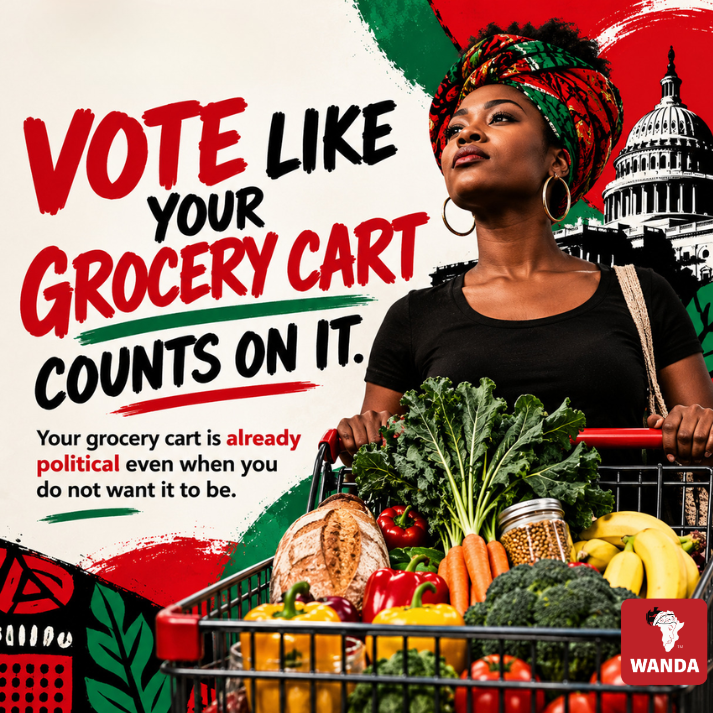
1. Your grocery cart is already political even when you do not want it to be.
Food recalls are not abstractions when the products being pulled from shelves are the foods families actually buy. In recent weeks alone, the FDA has posted recalls involving products potentially contaminated with Listeria, Salmonella, shiga toxin-producing E. coli, undeclared allergens, and other hazards. In 2026, the agency has also tracked major recall chains involving jalapeños linked to a multistate Salmonella outbreak and powdered milk associated with potential Salmonella risk.
That should remind us that food safety is not simply about individual responsibility. You can wash your hands, read labels, cook carefully, and still depend on a functioning public system of inspection, surveillance, research, regulation, and accountability. That system is shaped by public policy.
So when agencies are reorganized, enforcement priorities shift, environmental protections change, or scientific programs are weakened or strengthened, those choices eventually touch farms, water, air, food, and bodies.
2. Food safety and environmental health belong in the same conversation.

Our food system starts long before food reaches a grocery shelf but it begins with soil, water, workers, seeds, chemicals, weather, and land. That is why debates over the Environmental Protection Agency matter to food citizens. In 2026, federal environmental policy has continued to shift, including regulatory decisions affecting pesticides and broader environmental protections. Reuters has documented recent pesticide-industry victories and criticism from environmental and public-health organizations, while EPA says some of its decisions include tighter restrictions and more precise safeguards.
Glyphosate is a good example of why citizens need to stay engaged rather than rely on slogans from any side. EPA is currently reevaluating glyphosate and updating its human-health risk assessment, while HHS and EPA have created a new scientific partnership to expand the evidence considered in that review. The agencies say no final outcome has been predetermined.
That is more complicated than “safe” versus “unsafe.” And that is exactly why democracy matters. Food citizens should expect transparent science, meaningful public oversight, protection from conflicts of interest, and policies that balance farmer livelihoods with human and environmental health.
3. “Make America Healthy Again” is not a substitute for accountability.

Health movements rise because people are frustrated. Families are tired of diet-related disease. Farmers are tired of high input costs. Parents worry about additives, pesticides, ultra-processed foods, and what their children are exposed to. Those concerns deserve serious attention. But slogans must eventually become measurable policy.
This year, pesticide policy has already revealed tensions inside the MAHA coalition. The U.S. House removed language from its farm bill that would have shielded pesticide manufacturers from some lawsuits after opposition from MAHA activists, while separate court and regulatory battles over glyphosate, dicamba, and atrazine continue.
The lesson is bigger than any administration or movement: Do not outsource your citizenship to a slogan.
Watch what leaders fund. Watch what agencies enforce. Watch what gets delayed. Watch who benefits. Watch who bears the risk.
4. Tupac gave us a food-policy question in one line.
Years ago, Tupac put a contradiction into words that still lands:
“We got money for wars, but can’t feed the poor.”

That line survives because it is not really about scarcity but is about priorities.
A country can be extraordinarily wealthy and still decide that some children should arrive at school hungry, that some neighborhoods should lack healthy food retailers, or that farmers should struggle while multinational companies consolidate power.
Food democracy asks us to look directly at those choices.
Who gets subsidized?
Who gets protected?
Who gets fed?
Who gets heard?
5. Fannie Lou Hamer understood that the vote and the dinner plate were connected.

If we want a model for food democracy, we should remember Fannie Lou Hamer.
Hamer became a voting-rights organizer in Mississippi after learning in 1962 that Black people had the right to register to vote. Her attempt to register cost her her job and home, yet she continued organizing and later helped found the Mississippi Freedom Democratic Party. But Hamer did not stop at political participation.
She understood that political rights without economic power could remain fragile. In 1969, she founded the Freedom Farm Cooperative, helping Black families gain access to land, food, and economic opportunity. The cooperative grew into an important local employer and fed hungry people across racial lines. Hamer saw what many policy conversations still miss: the right to vote and the right to eat with dignity belong to the same struggle for self-determination. That is food democracy.
6. Black civic institutions are still carrying that tradition.

Today, many organizations rooted in Black communities continue nonpartisan civic-engagement work.
The NAACP, together with 100 Black Men of America, the National Urban League, Black Men Vote, Woke Vote, and State of the People, launched National Black Man Voter Day for October 24, with a goal of mobilizing 100,000 Black men through education, community conversations, faith networks, campuses, and local organizing.
The National Council of Negro Women operates its PowerUp civic-engagement strategy around voter education, protection, mobility, support, and communication, drawing on nearly 500 community and collegiate sections.
The National Pan-Hellenic Council, representing the Divine Nine, identifies civic engagement as one of its shared areas of service and collective action.
And Alpha Kappa Alpha Sorority, Incorporated includes voter education, public-policy awareness, civic engagement, grassroots organizing, and coalition building among its current social-action priorities.
These organizations matter because democracy is rarely sustained by information alone but is sustained through relationships. Churches. Sororities. Fraternities. Neighborhood associations. Alumni networks. Barbershops. Community organizations. Families.
The same principle applies in public health: trusted messengers matter.
7. Think like a Girl Scout: be prepared, not panicked.

The lesson is simple: Be prepared.
Any important civic event can involve waiting, changing weather, transportation problems, misinformation, or unexpected disruptions. Think ahead about your basic comfort and safety: water, medications, weather-appropriate clothing, comfortable shoes, a charged phone, and a portable charger if you have one.
And protect yourself from misinformation.
Do not trust a screenshot simply because a cousin sent it.
Do not trust a viral post because it has thousands of shares.
Do not trust urgency without verification.
When you see a claim about an election, ask: Who published this? Is it current? Is it official? Can I confirm it somewhere independent?
For official voting details, use your state or local election authority or established nonpartisan civic organizations. Vote Early Day also maintains national civic resources and nonpartisan voter guides.
8. Food democracy means showing up after Election Day too.

Voting is not the finish line but is one tool. Food citizens also attend school-board meetings when meal contracts are being discussed. We testify about food access. We ask who receives public procurement dollars. We follow farm bills and zoning decisions. We watch health departments. We support farmers markets and local businesses. We demand transparency when recalls happen. We ask whether Food Is Medicine programs are reaching the communities with the greatest need.
We keep asking the question: Who has power over the food system, and how do communities gain more of it? That question belongs in every city hall, statehouse, hospital boardroom, university, and kitchen.
9. Do not just boo. Build power.
Barack Obama once reduced the lesson to three words:
“Don’t boo. Vote.”
But Hamer’s life reminds us there is another sentence after that.
Do not just vote. Organize. And here are 4 action takes:
Bring your sisterfriends into civic conversations.
Talk about the issues at the dinner table.
Ask candidates and public officials about food safety, farming, maternal health, SNAP, environmental justice, school meals, and Food Is Medicine.
Keep receipts on what leaders promise and what institutions deliver because democracy should not be something done to us every few years but should be something we practice together.
WANDA’s Call to Action: Remember that you are a food citizen.
Every time we talk about food access, farm policy, pesticides, school meals, maternal health, grocery prices, climate resilience, or Food Is Medicine, we are talking about power.
October 24 is a reminder to pay attention to that power.
Learn the issues. Verify what you hear.
Stay engaged with trusted civic organizations.
Help people in your community find reliable information.
Ask harder questions of institutions.
And keep participating long after election season ends because the policies written in distant rooms eventually arrive at our farms, our grocery stores, our clinics, and our kitchen tables.
Food democracy begins when we remember that those tables belong to us too.


Comments