


.png)
Beyond the Clinic: Why WANDA Is Bringing Maternal Food as Medicine to the Black Maternal Health Movement

Updated: Aug 13

ATLANTA, GA— Every conversation about Black maternal health eventually arrives at the same sobering statistics. Black women in the United States remain significantly more likely to die from pregnancy-related causes than White women, regardless of income or education, while Black children continue to experience disproportionately high rates of obesity, food insecurity, and diet-related disease. But what if the conversation began somewhere different?
What if maternal nutrition was treated not as another educational intervention, but as essential public infrastructure?

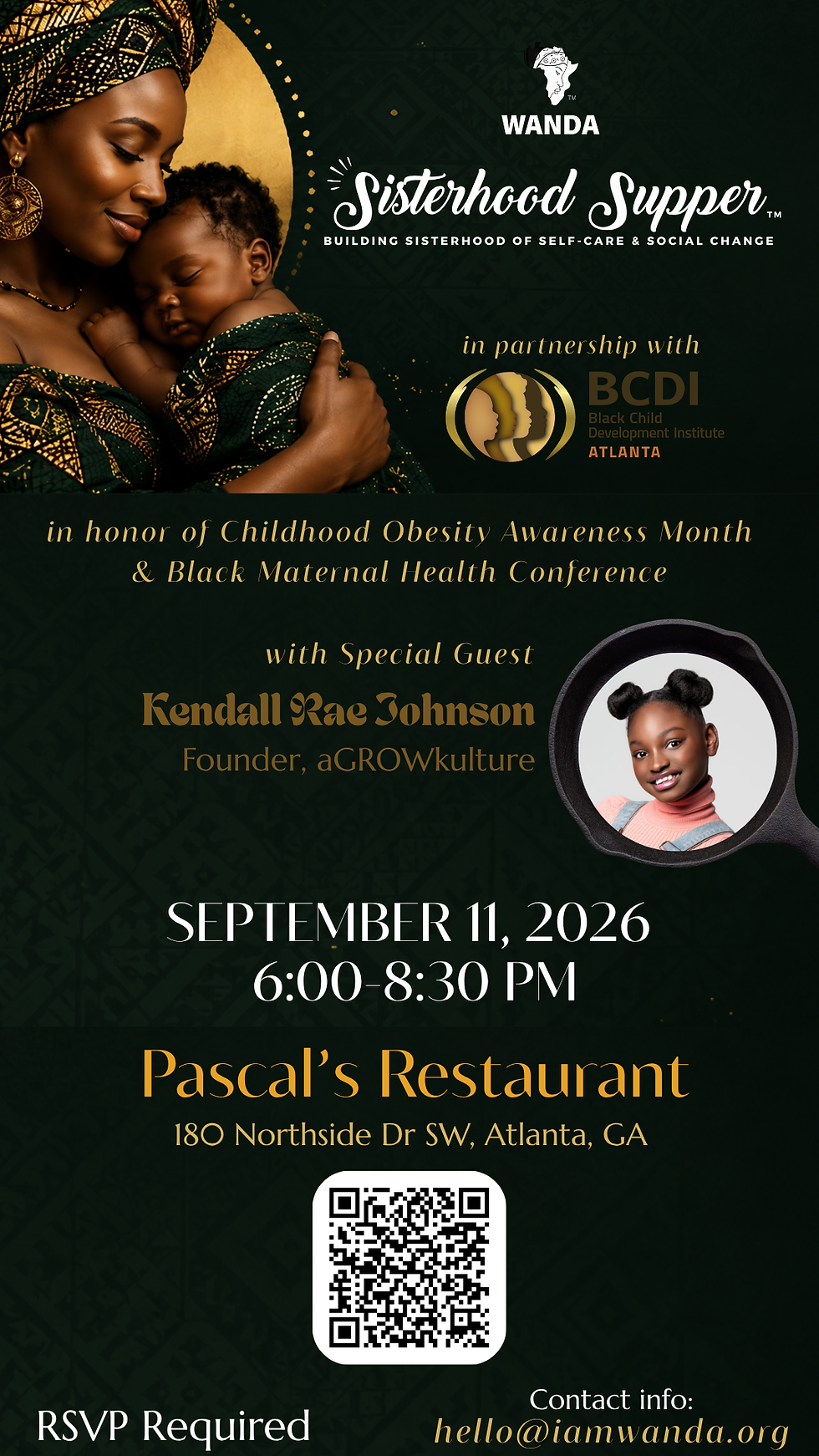
That is the question WANDA (Women Advancing Nutrition, Dietetics and Agriculture) will bring to Atlanta during the Black Mamas Matter Alliance's 2026 Black Maternal Health Training and Conference, where Founder and CEO Tambra Raye Stevenson, MPH, MA, will deliver a lightning talk on Maternal Food as Medicine. Following the conference, WANDA and the Black Child Development Institute (BCDI)-Atlanta will convene healthcare leaders, birth workers, educators, researchers, and families for a Sisterhood Supper: Atlanta at the historic Paschal's Restaurant. The timing is intentional.
September marks Childhood Obesity Awareness Month, reminding us that the foundations of lifelong health are often established long before a child enters school—and even before birth.
Reframing Nutrition as Infrastructure
For decades, maternal health policy has focused on expanding prenatal care, reducing mortality, and improving access to clinical services. Those investments remain essential. Yet nutrition frequently occupies the margins of maternal healthcare despite evidence linking maternal dietary quality to fetal growth, neurodevelopment, birth outcomes, and long-term chronic disease risk.
Stevenson believes this framing is incomplete.
"Too often we invest after disease appears," Stevenson said. "Nutrition is not simply education but infrastructure. When we nourish a mother, we influence a child's brain development, lifelong health, school readiness, and future productivity. Black mothers are not simply patients; they are architects of our communities."
The statement reflects WANDA's broader philosophy that food systems, maternal health, and child development are interconnected systems rather than isolated sectors.
The Forgotten History of Black Maternal Nutrition
Long before nutrition science became an academic discipline, Black women practiced food as medicine.
Across the African diaspora, grandmothers prepared mineral-rich broths after childbirth, fermented foods to support digestive health, herbal infusions for recovery, and nutrient-dense meals that reflected generations of ecological and cultural knowledge. Midwives and community healers understood that caring for a mother was inseparable from caring for a child.
Much of that knowledge survived enslavement, segregation, and migration. Yet it rarely appears in mainstream conversations about maternal health. Instead, public health discussions often focus narrowly on clinical interventions while overlooking food traditions that sustained families under extraordinary circumstances. WANDA argues these traditions deserve renewed attention, not as nostalgia, but as community assets that can complement evidence-based care.
Childhood Obesity Begins Before Childhood
The Centers for Disease Control and Prevention estimates that nearly one in five U.S. children lives with obesity, increasing the risk of diabetes, cardiovascular disease, and other chronic conditions later in life. Increasingly, researchers recognize that prevention begins before birth. Maternal nutrition influences fetal programming, metabolic development, and lifelong health trajectories. This emerging body of evidence suggests that investments during pregnancy may generate benefits extending far beyond infancy.
For WANDA, that transforms maternal nutrition into both a public health and economic issue. Black mothers make billions of dollars in household purchasing decisions annually related to food, childcare, and healthcare. Strengthening maternal nutrition knowledge and confidence can influence family food environments, child development, and community well-being.
Why a Sisterhood Supper?
The conference presentation concludes in a setting that reflects WANDA's organizing philosophy: the dinner table. Following the Black Mamas Matter Alliance conference, WANDA and BCDI-Atlanta will host a Sisterhood Supper at Paschal's Restaurant, a historic gathering place during the Civil Rights Movement where activists once strategized between meals.
For Stevenson, the location is symbolic. Social movements have always relied on tables.
Church suppers sustained organizing. Freedom kitchens fed marchers. Family meals preserved culture. Today, WANDA sees shared meals as civic and public health infrastructure—spaces where evidence, lived experience, and community leadership intersect.
Participants will engage in conversations about maternal nutrition, early childhood development, food culture, and community solutions while sharing a culturally rooted meal.
The evening will also feature Kendall Rae Johnson, founder of aGROWkulture and Georgia's youngest certified farmer, whose work reconnects children to gardening and agriculture.
Her presence reflects WANDA's belief that cultivating healthy eaters begins with cultivating curiosity.
Building a New Maternal Food Ecosystem
The Sisterhood Supper will preview WANDA's expanding maternal and child health initiatives, including NOURISH Maternal Food as Medicine and WANDA's World, which equip mothers, doulas, birth workers, educators, and caregivers with culturally responsive nutrition education and trusted resources from pregnancy through early childhood.
These initiatives represent an emerging framework that integrates maternal nutrition, cultural foodways, storytelling, and leadership development rather than treating them as separate interventions.
For BCDI-Atlanta, the partnership reflects a shared commitment to strengthening Black families through community-centered approaches.
"Healthy child development starts long before a child enters kindergarten," said Tatjyana Elmore, M.Ed., President of BCDI-Atlanta. "Our partnership with WANDA celebrates Black families as leaders and innovators while connecting culture, nutrition, and community to help every child thrive."
Beyond Awareness
Childhood Obesity Awareness Month often emphasizes individual behavior change.
WANDA is asking a different question. What would happen if America invested as much in nourishing mothers as it does in treating chronic disease?
The answer may shape not only healthier pregnancies, but healthier generations.
Join WANDA in Atlanta
WANDA x BCDI-Atlanta [RSVP LINK]
Sisterhood Supper
Friday, September 11, 2026
6:00 - 8:30 p.m.
Paschal's Restaurant (Private Dining Room)
Atlanta, Georgia
Proceeds support maternal nutrition education, birth worker training, and early childhood health initiatives. Learn more at iamwanda.org.


Comments