


.png)
If Better Farming Makes Better Food, Who Gets to Be Better Nourished?

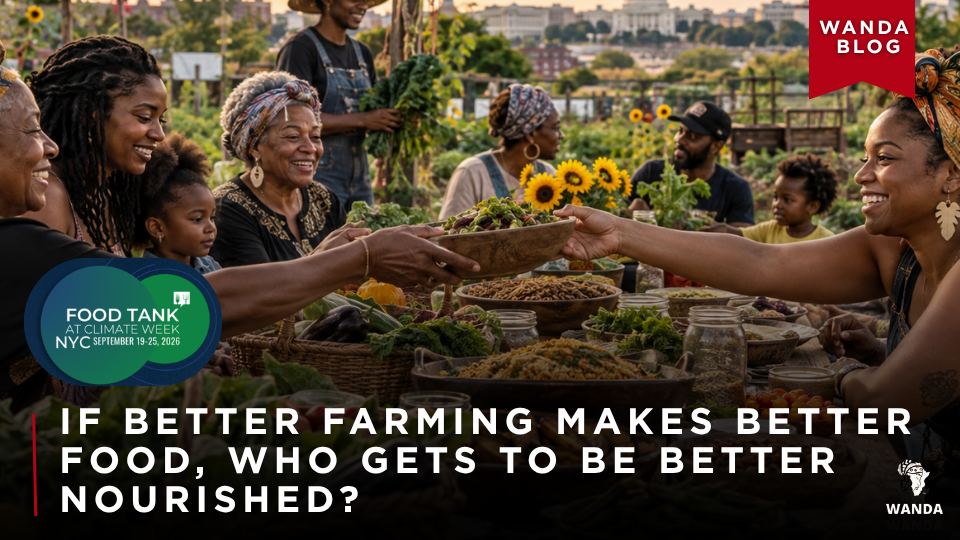
WANDA Founder Tambra Raye Stevenson joins Food Tank and Diestel Family Ranch during Climate Week NYC to push the conversation about nutrient density from the farm all the way to the families, communities, and cultures our food system is supposed to nourish.
There is something hopeful about a room full of farmers, scientists, food companies, health leaders, and advocates asking how the way we grow food might help us live longer and healthier lives. There is also a question we cannot afford to leave outside that room: If we succeed in producing more nutrient-dense, regenerative, thoughtfully raised food, who will actually have the opportunity to eat it?

That question will travel with WANDA to New York City on Tuesday, September 22, when Founder and CEO Tambra Raye Stevenson joins Food Tank and Diestel Family Ranch for “Nourishing the Future: How Farming Practices Shape the Food We Eat, the Health We Build, and the Longevity We Seek,” an official Climate Week NYC event at WNYC-NPR Studios’ The Greene Space.
The invitation-only summit, which will also be available by livestream, brings agriculture and health into the same conversation at a time when the food world is paying greater attention to regenerative production, soil biology, animal health, nutrient density, Food Is Medicine, and the relationship between what happens on farms and what eventually happens inside our bodies.
For WANDA, that connection has always been essential. But Stevenson is coming to Climate Week with another piece of the equation: Better food cannot improve health if the people who could benefit from it cannot afford it, find it, trust it, recognize themselves in it, or participate in shaping the systems that deliver it.
“Food is medicine begins long before food reaches the clinic or the plate,” Stevenson said. “How we grow, produce, communicate about, and create access to food ultimately shapes who has the opportunity to be nourished and thrive. I’m excited to join Food Tank, Diestel Family Ranch, and fellow leaders during Climate Week NYC to explore what it means to build a food system that produces not only better food, but better health.”
What Are We Growing For?
Stevenson will join Una Hrnjak, Group Director for International Sustainability at ALDI SOUTH Group; Paul Lightfoot, General Manager of Patagonia Provisions; and Kristine Root, Chief Strategist and Founder of Socha, for the afternoon panel “What Are We Growing For? The End of Cheap Food and Rethinking the Future of American Farmland.” Food Tank President and Co-Founder Danielle Nierenberg will moderate the conversation.
The title gets to the heart of an increasingly uncomfortable question. For decades, American food policy and commerce have rewarded qualities that can be easily counted: yield, volume, speed, shelf life, convenience, and price. Those measures matter. Families absolutely know the importance of price when a grocery bill competes with rent, child care, transportation, medicine, and everything else required to keep a household going. Farmers know what happens when the economics of producing food simply do not work.
But what happens when “cheap” food carries costs that never appear on the receipt?
Those costs can show up in depleted soil, disappearing farmland, pressure on farmers, environmental damage, worker health, communities with little control over their food environments, and ultimately in a health system attempting to manage diet-related diseases downstream. The challenge now is not to romanticize expensive food or suggest that families should simply pay more. It is to ask whether the price on the shelf has ever told us the whole truth about value.
If a carrot contains more nutrients because of how its soil was managed, that matters. If an animal is raised under conditions that affect the quality of the food it produces, that matters. If biodiversity strengthens a farm’s resilience, that matters. But affordability matters too. So does culture. So does labor. So does whether small and historically excluded farmers can remain on their land. So does whether a mother can find nourishing foods in her neighborhood and prepare them in ways her family will actually eat. Nourishment has never been merely a laboratory measurement.
From the Soil to the Story We Tell About Health
The Climate Week summit will begin with the science. A panel on nutrient density will bring together leaders from Whole Foods Market, the Periodic Table of Food Initiative, the Tufts Food is Medicine Institute, and the New York State Department of Agriculture and Markets to consider how soil, farming practices, animal health, and production choices influence the nutritional composition of food.
That research holds tremendous promise. WANDA’s contribution is to insist that science and lived experience belong in conversation with one another. Stevenson, trained in nutrition and public health and now completing doctoral work in communication, has spent much of her career examining the distance between what health experts know and what communities can actually use. Science can identify nutrients. It can measure biomarkers and disease risk. It can tell us a great deal about what food does inside the body. Communication helps answer a different set of questions: Who delivers that knowledge? Who is trusted? Whose food traditions are treated as legitimate? Does a recommendation make sense in the context of somebody’s household, culture, income, neighborhood, and daily life?
WANDA calls attention to that space because a more nutritious food supply does not automatically become a more nourishing society. The work is not finished when we grow a better tomato. We still have to ask whether the family who needs it can buy it, whether the store nearby carries it, whether our institutions purchase it, whether children are learning to value it, whether the farmer who grew it can build a viable livelihood, and whether nutrition professionals know how to talk about it without asking communities to abandon their cultures in the name of health.
Food Is Medicine Starts Before the Prescription
The rapid growth of Food Is Medicine has helped bring food more explicitly into conversations about clinical care. Produce prescriptions, medically tailored meals, nutrition interventions, and food benefits are creating new pathways for health systems to address diet-related conditions.
WANDA welcomes that movement while asking the food and health sectors to widen the lens. If food is medicine, then the medicine has an origin story. Someone planted it. Someone raised it. Someone harvested it, processed it, packaged it, transported it, stocked it, purchased it, prepared it, and passed knowledge about it from one person to another. The health value of food is therefore connected not only to nutrients but also to the agricultural, economic, environmental, and social systems surrounding it.
That is particularly important when Food Is Medicine reaches Black mothers and families, communities that have too often been approached as collections of health disparities rather than sources of knowledge and leadership. WANDA’s work through maternal Food Is Medicine, Sisterhood Suppers, WANDA Scholars, and its emerging WANDA’s World begins with a different premise: Communities should not only receive healthier interventions. They should have a role in shaping them.
The question is not simply whether health systems can prescribe good food. It is whether farmers from the communities being served can participate in supplying it, whether the foods reflect culture and heritage, whether community health workers and birth workers are recognized as trusted messengers, and whether the economic opportunity created by Food Is Medicine circulates back into the communities carrying the greatest burden of diet-related disease.
Nutrient Density Cannot Become Another Luxury
There is another tension worth naming at a Climate Week gathering focused on the future of food. “Nutrient dense” cannot become another premium label available primarily to people who can afford to shop their values.
We have seen versions of this story before. Organic food, wellness products, specialty markets, and farm-to-table dining can begin with worthwhile ideas and still develop into markers of class and exclusivity. Meanwhile, communities experiencing the greatest burden of preventable disease are told to improve their diets while navigating food prices, transportation barriers, time constraints, aggressive marketing, and neighborhoods shaped by generations of unequal investment. The opportunity with nutrient density is to resist repeating that pattern.
If emerging science helps farmers understand how agricultural practices can improve the nutritional quality of food, that knowledge should inform more than high-end retail. It should reach school meals, maternal-health programs, hospitals, community institutions, grocery stores, food assistance programs, and the public purchasing systems that feed millions of people every day.
The goal should not be a two-tiered food future in which some Americans purchase nourishment while everyone else purchases calories. That would not be transformation. It would simply be inequality with better branding.
Black Women Belong in the Future of Farming and Food
For Stevenson, this conversation is also personal. Her family roots extend across five generations in Oklahoma, with a history connected to livestock agriculture, ranching, cooking, and the work of feeding people. WANDA grew from that history and from a concern that national conversations about the food system frequently discuss Black women as consumers or populations at risk while overlooking their long record as agricultural workers, farmers, cooks, caregivers, scientists, entrepreneurs, nutrition professionals, organizers, and innovators.
If Climate Week is asking what the future of farmland should become, then WANDA is asking who will have the opportunity to shape it. That means thinking about young Black girls who may never have been encouraged to imagine careers in agriculture, nutrition science, food technology, or agricultural engineering. It means investing in women farmers and entrepreneurs. It means remembering Black scientists whose contributions transformed food safety and nutrition. It means ensuring that the people whose communities experience the health consequences of our current food system are present when the next one is designed.
WANDA’s philosophy has always been “from farm to health,” because no single profession owns the solution. Farmers need nutrition scientists. Nutrition scientists need communities. Health systems need growers. Entrepreneurs need capital. Families need trustworthy information. And all of them need storytellers capable of making the connections visible.
From Cheap Food to Food Worth Valuing
The panel’s reference to “the end of cheap food” deserves careful consideration because the answer cannot be to make families bear even more of the financial burden. Americans are already feeling the pressure of food costs. Farmers are confronting their own economic pressures. Small producers operate in markets where scale can determine survival.
The more useful conversation is about what society chooses to value and where the costs are distributed.
If we value soil health because it contributes to long-term productivity and ecological resilience, how do we ensure farmers can afford to protect it? If we value nutrient density, how do we prevent it from becoming a luxury commodity? If we believe regional agriculture strengthens food security, how do schools, hospitals, universities, and retailers use their purchasing power to support it? If healthier food reduces long-term health burdens, how should that value be reflected in the way health care and public institutions invest upstream?
And if we believe Black communities deserve better health, how do we move from studying disparities to investing in Black farmers, food businesses, nutrition professionals, community organizations, and children who could become tomorrow’s food-system leaders?
Those are economic questions as much as nutritional ones.
What Happens on the Farm Does Not Stay There
Food Tank’s event brings together voices from farming, retail, science, public health, sustainability, food companies, and media because the health of the food system cannot be solved from one end of the supply chain.
The afternoon will include a fireside conversation with fourth-generation farmer Heidi Diestel, a scientific discussion of nutrient density, a family-farm perspective from Jason Diestel, Stevenson’s panel on farmland and the value of food, a farmer story from Elder Raymond Bryant of the San Antonio Million Gardens Project, and a closing conversation featuring chef, author, and food advocate Andrew Zimmern with The New York Times food reporter Melissa Clark.
That mix is part of what makes this Climate Week conversation worth watching. Farming practice is not simply an agricultural concern. Nutrition is not simply a clinical concern. Climate is not simply an environmental concern. They meet in the same place eventually: our bodies, our families, and our communities.
As Food Tank President and Co-Founder Danielle Nierenberg notes in a proposed statement for the event, Stevenson brings a perspective that connects Food Is Medicine with culture, communication, equity, and community voice, while reminding the food movement that producing more nutritious food is only part of the work.
Join WANDA at Climate Week NYC
“Nourishing the Future: How Farming Practices Shape the Food We Eat, the Health We Build, and the Longevity We Seek” takes place on Tuesday, September 22, 2026, from 1:30 to 4:30 p.m. at WNYC-NPR Studios’ The Greene Space, 44 Charlton Street in New York City. The program is presented by Food Tank and Diestel Family Ranch as part of Climate Week NYC. Register today!
The in-person gathering is invitation-only, with guest registration available through Food Tank, and the program will also be livestreamed for audiences outside New York.
For WANDA, the trip to Climate Week is an opportunity to bring a question we ask everywhere we go from Sisterhood Suppers and maternal-health programs to classrooms, farms, boardrooms, and community tables. If better farming can give us better food, then our measure of success cannot stop at what is produced. We have to ask who gets nourished.


Comments