


.png)
Who Gets to Own the Table?


WANDA Returns to Washington’s Food Justice Conversation
Back by popular demand, “Addressing the Future of Food Justice and Sovereignty in Washington, DC” returns September 19 at Bowie State University with a deeper question for the region: What will it take for Black communities to move from simply gaining access to food to having meaningful power over the systems that feed us?

On Saturday, September 19, 2026, from 11:15 a.m. to 12:30 p.m., WANDA Founder and CEO Tambra Raye Stevenson will return to the Center for Engagement, Environmental Justice and Health INpowering Communities’ Annual Environmental Justice and Health Disparities Symposium at Bowie State University for the panel, “Addressing the Future of Food Justice and Sovereignty in Washington, DC.” Back by popular demand, the conversation returns at a time when questions about food affordability, public investment, land, health, neighborhood change, and community ownership are becoming increasingly difficult to separate. For WANDA, the conversation begins with a simple truth: Getting food into a community is important, but it is not the same as ensuring that the community has the power to shape the system responsible for feeding it.
That distinction between food access and food sovereignty sits at the center of the discussion. Food justice is often understood through the immediate and necessary work of ensuring that families can obtain nutritious, affordable, and culturally relevant food. Food sovereignty asks us to go further by examining who owns agricultural land, who controls distribution, who receives institutional purchasing contracts, whose businesses are financed, whose knowledge is recognized, who develops food and health technologies, and who participates in the decisions that determine what ultimately reaches our tables. For Black communities in Washington, DC, and across the region, the future of food justice cannot be measured solely by the number of grocery stores, farmers markets, or programs operating in a neighborhood. It must also be measured by the amount of ownership, wealth, leadership, and decision-making authority that remains within the community.
“Food access gets us to the table, but food sovereignty asks who owns the table, who grew what is on it, who was paid, whose traditions shaped the meal, and whether our children will inherit enough power to set the table for themselves,” Stevenson said. “We cannot measure progress only by how much food enters Black communities. We also have to measure how much land, capital, knowledge, infrastructure, and decision-making power remain in community hands.”
The 2026 symposium creates a particularly meaningful setting for that conversation. Since 2011, CEEJH INC has worked alongside frontline and fenceline communities to address environmental, climate, energy, and health inequities through grassroots engagement, research, and policy co-creation. This year’s symposium, organized under the theme “EJ 2076: Make America JUST Again” and the tagline “A 50-Year Plan to Advance Democracy, Environmental Justice, and Health Equity,” invites participants to think well past the immediate moment. As the United States marks its 250th anniversary, CEEJH is asking communities to examine where environmental and health inequities originated, how they continue to shape daily life, and what must be built now if the nation is to look fundamentally different by its 300th anniversary in 2076.
That long view matters when we talk about food because inequities in the food system did not arrive overnight. Washington-area communities have spent generations confronting hunger, unequal grocery access, displacement, loss of land, underinvestment in Black-owned businesses, inadequate transportation, food affordability, diet-related illness, and the disappearance of neighborhood institutions that once sustained local food culture. Those conditions have often been described primarily as problems of access. Yet access alone cannot answer the deeper question of who possesses economic and political power within the food system. A community may finally attract a grocery store and still have no ownership stake in that store. A hospital may offer produce prescriptions while purchasing little from local growers. A neighborhood may celebrate an urban farm while the farmer remains vulnerable to losing the land beneath it. A nutrition program may encourage culturally appropriate eating while excluding the very growers, cooks, caregivers, and community experts who carry that cultural knowledge.
Moderator Tamara Dickerson describes food justice as a question not only of nourishment, but also of power. “Food justice is about more than making sure people have enough to eat. It is about communities having the power to shape the systems that determine what food is available, who benefits economically, and whose voices and traditions are valued,” Dickerson said. “This conversation gives us an opportunity to move from identifying inequities to asking what food sovereignty can actually look like in practice. We must take control of our food systems, establish more community-led initiatives to become more empowered in the decision-making regarding food equity and access.”
That emphasis on community control also connects directly to the work of E. Fatimah Hasan, Policy Facilitator and Coordinator for the Ujamaa Cooperative Farming Alliance, whose perspective brings seeds, traditional foodways, and local agricultural knowledge into the conversation about sovereignty. “It is a matter of the utmost importance that our community organizes around obtaining the best quality of food we can and sourcing our food from within our own community,” Hasan said. “We can do this by supporting our local farmers, cultivating our own food if we can, saving our seeds, and gravitating toward healthier eating habits. We must honor our traditional foodways that fortify our bodies, minds, and spirits.”
Saving seeds may sound like a small act in comparison with the enormous scale of the modern food system, but seeds carry history, memory, possibility, and power. They connect generations of growers to the foods that sustained families long before those foods appeared in wellness trends or on specialty grocery shelves. They also remind us that sovereignty is not an abstract policy concept. It can live in the ability to grow food, preserve culturally significant crops, maintain agricultural knowledge, share that knowledge with the next generation, and decide collectively what deserves to endure.
For WANDA, that history is inseparable from the leadership of Black women. Black women have long done the work of feeding families, protecting food traditions, managing household food economies, farming, cooking, educating, organizing, caring, and creating businesses. Too often, however, the resources attached to that labor have flowed elsewhere. The next era of food justice must therefore ask whether women are receiving the ownership, compensation, investment, recognition, and governing authority that correspond with the leadership they have already demonstrated.
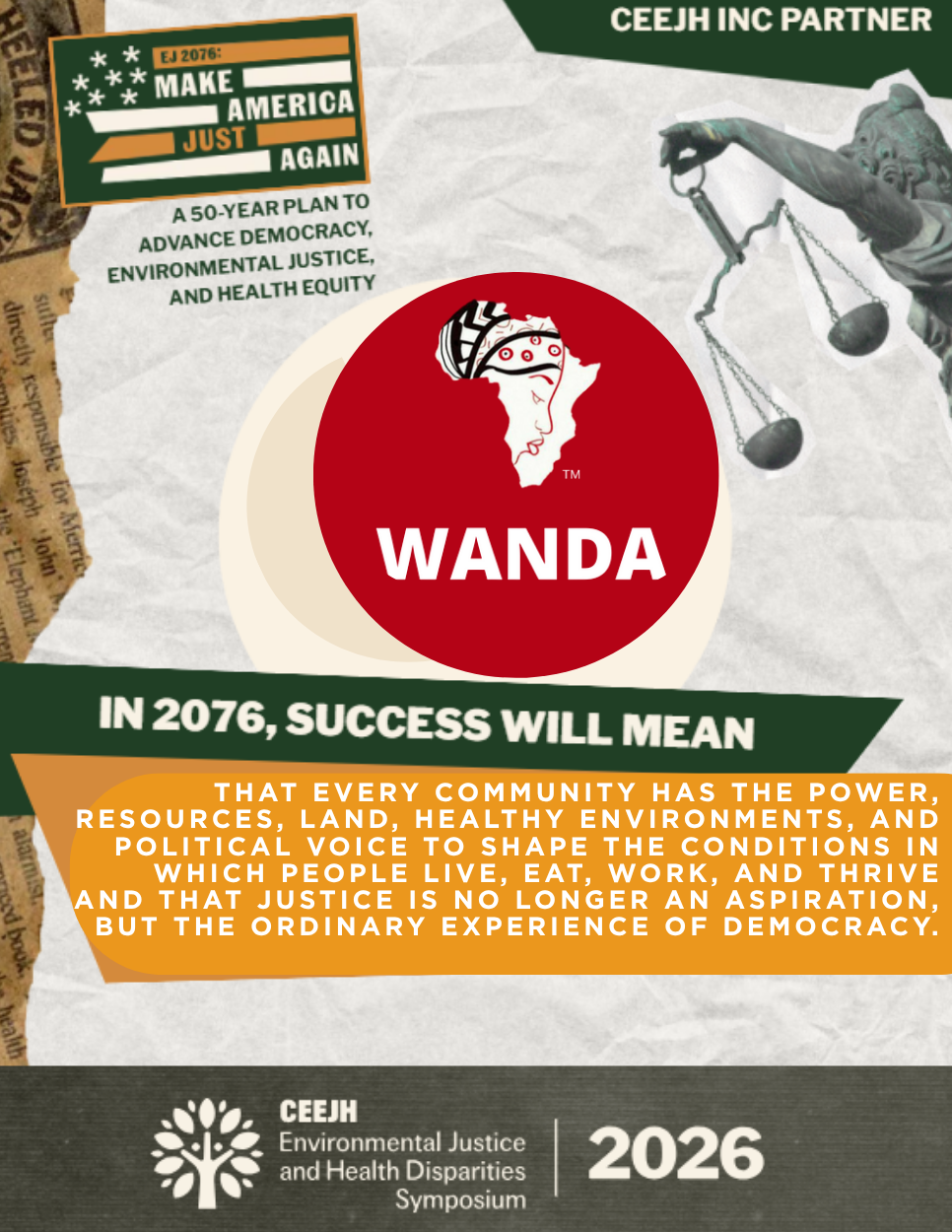
WANDA was founded with precisely that concern in mind. For more than a decade, Women Advancing Nutrition, Dietetics, and Agriculture has worked to build a pipeline for women and girls of African descent to lead across the continuum from farm to health. Through initiatives such as WANDA Scholars, NOURISH Maternal Food as Medicine, Sisterhood Suppers, Little WANDA, WANDA’s World, and its food-rights advocacy, the organization has consistently challenged the idea that Black women should be discussed only as populations experiencing disparities. Black women are also farmers, nutrition professionals, scientists, entrepreneurs, chefs, birth workers, researchers, educators, caregivers, storytellers, and community leaders whose expertise is essential to building healthier food systems.
For Stevenson, the stakes become even greater as food, health care, media, and technology converge. “The future food system will not only be built in fields, grocery stores, and kitchens. It is also being built through health care, procurement systems, media, artificial intelligence, algorithms, and data,” Stevenson said. “If we are serious about food sovereignty, Black communities cannot simply be the consumers, patients, or data points at the end of those systems. We have to be among the farmers, founders, scientists, technologists, storytellers, and decision-makers building them.”
That approach also requires reconsidering the language used to describe inequity. WANDA uses the term food apartheid rather than food desert because a desert is a naturally occurring ecosystem, while unequal access to nutritious and affordable food is the result of human decisions. Patterns of segregation, transportation investment, land use, retail development, housing, agricultural policy, lending, and neighborhood disinvestment have all influenced which communities receive resources and which communities have historically gone without them. Calling the condition food apartheid directs attention toward structures and power, while also reminding us that systems created through policy and investment can be changed through different policy and investment choices.
The distinction becomes especially visible when neighborhoods experience gentrification. Communities that spent decades asking for grocery stores, safe parks, fresh-food retailers, and public investment can eventually see those amenities arrive alongside rising rents and displacement. The painful irony is that a neighborhood may become “healthier” on paper at the same moment longtime residents become unable to afford to remain there. Restaurants, small food businesses, community gardens, churches, neighborhood markets, and informal networks of food exchange can disappear as property values rise. A food-justice framework concerned only with access can miss this contradiction. Food sovereignty requires us to consider whether people can remain in place long enough to benefit from the improvements they fought to create.
Local farmers must also be understood as part of a region’s health and resilience infrastructure, rather than simply as vendors consumers encounter at weekend markets. Farmers protect agricultural knowledge, steward land, grow culturally significant crops, educate children, create jobs, shorten supply chains, and strengthen regional food security. Yet asking individuals to “buy local” cannot substitute for institutional change. Schools, universities, hospitals, local governments, restaurants, and health systems possess purchasing power that can determine whether small and historically excluded farmers are able to grow sustainable businesses. If the region wants stronger local food systems, its largest institutions must examine where their food dollars go and whose businesses those dollars help build.
This is also why WANDA encourages people to think of themselves not simply as food consumers or foodies, but as food citizens. Consumers understandably ask what they should purchase, what they can afford, and what might be healthier for their families. Food citizens are invited to ask another set of questions: How did these become my choices in the first place? Who owns the businesses in my neighborhood? Where does my child’s school purchase food? Which farmers receive public contracts? Who controls agricultural land? What happens to a community garden when development arrives? Who sits on the boards and commissions that make food-policy decisions? Whose ideas receive funding, and whose expertise is considered credible?
Those questions move us from individual behavior toward collective responsibility. They also make room for a more honest understanding of health. Communities cannot shop their way out of every structural inequity, and families cannot be expected to solve through individual food choices what has been created through generations of policy, investment, and economic decision-making. Personal choices matter, but people also deserve the power to shape the conditions under which those choices are made.
CEEJH’s 2076 framework invites the region to imagine what success might look like 50 years from now. Perhaps food sovereignty in Washington would mean more Black families holding land across generations, more community-owned grocery stores and cooperatives, more Black farmers receiving institutional contracts, and more neighborhood food businesses retaining wealth locally. Perhaps it would mean culturally relevant foods being embedded in health care and nutrition programs without being stripped of their histories, more children seeing agriculture and nutrition as viable professions, and more women receiving financial investment that reflects the labor and leadership they contribute. It might also mean communities holding meaningful authority over the research, data, technology, and public investments made in their names.
Food sovereignty does not require every family to grow every meal it eats, nor does it reject the role of government, markets, institutions, or regional commerce. It asks whether communities possess enough durable power, resources, and infrastructure to meaningfully influence how they are fed and whether future generations will inherit greater choices than the generations before them.
“Addressing the Future of Food Justice and Sovereignty in Washington, DC” will take place on Saturday, September 19, 2026, from 11:15 a.m. to 12:30 p.m. at Bowie State University's Martin Luther King, Jr. Center as part of CEEJH INC’s Annual Environmental Justice and Health Disparities Symposium. The symposium brings together residents, community leaders, advocates, researchers, students, practitioners, and policymakers to advance environmental justice and health equity through community-centered dialogue and action.
Registration and additional information are available through the CEEJH Environmental Justice and Health Disparities Symposium.
As Washington looks toward 2076, the question before us is larger than whether every neighborhood can eventually point to a place where residents can purchase healthier food. The question is whether the people who have spent generations feeding, organizing, creating, and caring for our communities will possess enough land, capital, ownership, knowledge, and political power to determine what the next food system becomes.
Food justice asks whether our communities can eat. Food sovereignty asks whether our communities can decide.


Comments